In the fast-paced world of Fast-Moving Consumer Goods (FMCG), inventory management is a balancing act. While inventory is an asset, it can quickly become a liability if not managed properly. Excess inventory ties up capital, increases holding costs, and clogs warehouses, while insufficient inventory harms service levels, leads to backorders, and damages customer loyalty.
Days Inventory Outstanding (DIO) is a critical Key Performance Indicator (KPI) in this context, yet many FMCG companies, particularly in Southeast Asia, struggle to keep it under control. Traditional cost-cutting measures often increase supply risks and destabilize On-Time In-Full (OTIF) performance, leading to operational chaos.
However, there is a smarter approach to reducing DIO. It involves redesigning inventory decision-making processes rather than merely cutting inventory levels. This guide outlines how FMCG companies can reduce DIO safely and sustainably.
1. Start with Visibility: Understand Where and Why Inventory Builds Up
FMCG supply chains accumulate inventory at various points, such as:
- Factory finished goods
- Regional distribution centers
- Local market hubs
- Distributor warehouses
- Trade inventory (modern & traditional trade)
To responsibly reduce DIO, businesses must address the following questions:
- Where is inventory sitting?
- Which SKUs are driving the excess?
- What is the demand and replenishment variability behind those SKUs?
- Is the inventory build-up intentional (buffer) or accidental (process failure)?
Most companies find that 60–70% of inventory sits in the wrong place due to low visibility rather than high demand.
2. Rebuild Safety Stock Logic: Move Beyond the “One-Size-Fits-All” Buffer
Traditional safety stock formulas do not account for the complexity of FMCG portfolios, which include:
- High runners
- Seasonal SKUs
- New product launches
- Slow movers
- Promo-driven items
- Short shelf-life SKUs
A modern safety stock strategy should involve:
- Demand segmentation (A/B/C + volatility indexing)
- Service class differentiation
- Lead-time variability mapping
- Shelf-life constraints
- Statistical forecasting (rather than manually padded numbers)
Precise safety stock rules ensure inventory aligns with demand, reducing DIO without compromising service.
3. Fix Replenishment Rules: The Most Common Cause of Excess
Outdated replenishment logic can result in excess inventory. Common issues include:
- Disconnection from true demand
- Minimum Order Quantity (MOQ) constraints
- Sales pressure
- Fixed cycles instead of real-time signals
To address these, companies should adopt:
- Dynamic reorder points
- Replenishment based on consumption patterns
- MOQ negotiation or re-balancing
- Collaborative planning with distributors
- Shorter order cycles where feasible
Small changes in replenishment cadence can reduce inventory by 10–20% without affecting OTIF.
4. Improve Forecast Accuracy — Even a Small Lift Helps
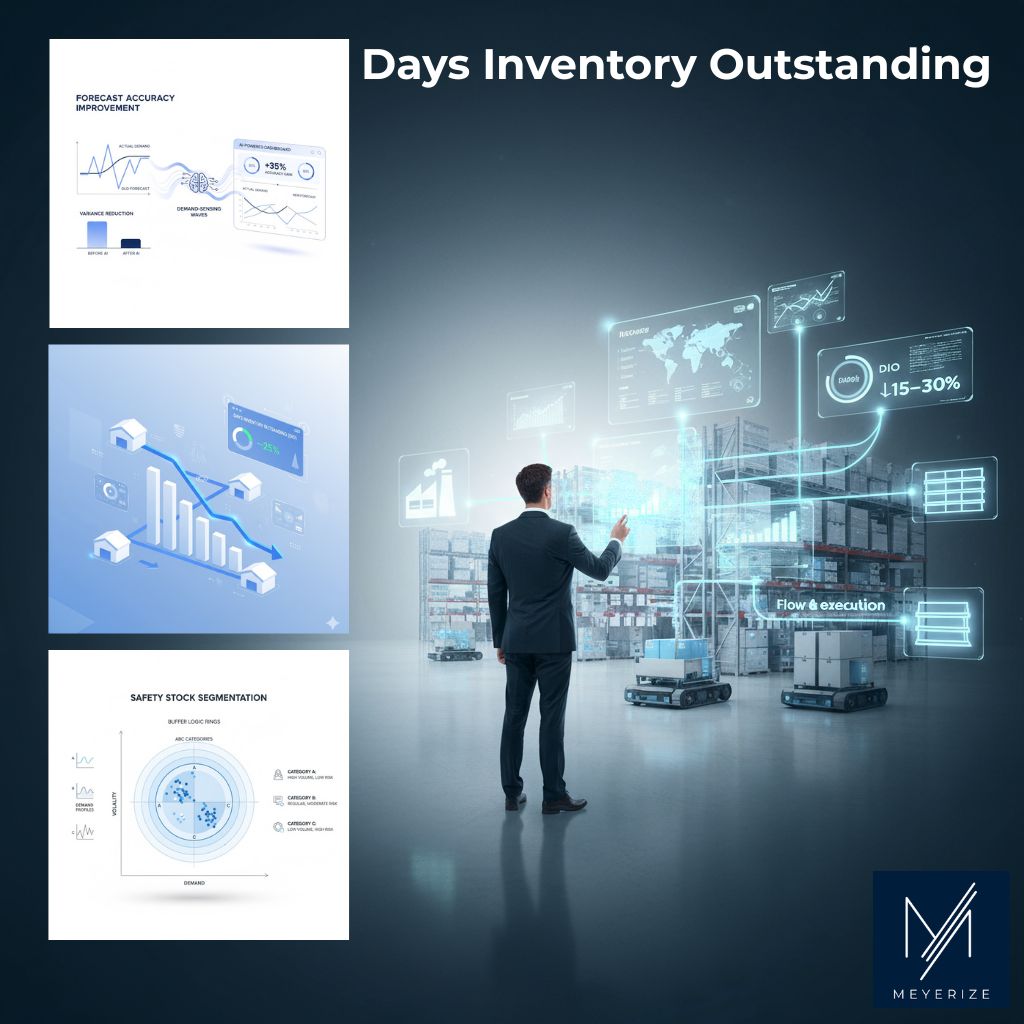
While perfect forecasting isn’t necessary, better forecasting can optimize DIO. A 5–10% improvement in forecast accuracy can reduce DIO by:
- 8–15% for stable categories
- 15–25% for high-variability categories
Focus areas should include:
- Eliminating manual forecast overrides
- Using short-term demand sensing
- Incorporating real consumption and sell-through data
- Tightening the S&OP/S&OE loop
- Forecasting at the right aggregation level
Better alignment between sales, demand, and supply planning translates to lower inventory levels with less panic.
5. Balance Inventory Across the Network — The Most Underrated Lever
Often, the issue is not having too much inventory but having it in the wrong place. Balancing inventory across the network can release:
- 10–30% inventory
- Without reducing total safety stock
- While improving OTIF
Tools to achieve this include:
- Deployment logic
- Multi-Echelon Inventory Optimization (MEIO)
- SKU-by-SKU rebalancing
- Cross-border visibility
- Inventory return or swap mechanisms
Better distribution leads to lower DIO and higher service levels.
6. Strengthen Plan Adherence: The Glue That Makes Everything Work
Plan adherence ensures teams follow through with production, procurement, and distribution plans. It involves:
- Production following the cycle
- Procurement aligning purchases to demand
- Logistics executing replenishment rhythm
- Sales respecting inventory thresholds
- Avoiding last-minute firefighting and emotional ordering
Strong plan adherence can drive 5–10% inventory reduction and result in smoother operations and more predictable service.
Conclusion: Reducing DIO Isn’t About Cutting — It’s About Redesigning
Successful FMCG companies focus on engineering inventory:
- Headquartered in demand reality
- Balanced across the network
- Supported by algorithmic logic
- Governed by strong planning rhythms
- Protected from volatility
- Fine-tuned continuously
By building this ecosystem correctly, companies can reduce DIO by 15–30% without compromising service levels, availability, or customer trust. This strategic approach can help FMCG leaders win in the competitive Southeast Asian market by combining logistics expertise with measurable planning improvements and hands-on network optimization.